IT Asset Discovery: The Complete Guide to Tools, Techniques, and Best Practices
Organizations today operate across dozens of cloud providers, SaaS platforms, and remote environments — and every new service creates another asset that attackers can find and exploit. The problem is not that companies lack security tools. The problem is that most security teams do not have a complete, up-to-date inventory of what they need to protect in the first place.
That is exactly what IT asset discovery solves. It is the foundational process of identifying, cataloging, and continuously monitoring every technology asset an organization owns or operates — from domains and subdomains to cloud instances, exposed services, and employee data visible from the outside.
Without reliable asset discovery, vulnerability scanners miss targets, compliance audits have blind spots, and incident response teams waste critical time figuring out what they are dealing with. Research consistently shows that unknown assets are among the most common initial entry points in breaches. You cannot secure what you cannot see.
This guide covers everything security teams, IT managers, and consultants need to know about asset discovery: what it is, how it works, the techniques and tools available, and how to build a program that keeps pace with a constantly changing environment.
What Is Asset Discovery?
Asset discovery is the process of identifying and cataloging all technology assets associated with an organization. This includes hardware devices, software applications, cloud resources, network infrastructure, domains, subdomains, IP addresses, and any other digital resource that could represent a security risk or operational dependency.
In traditional IT environments, asset discovery focused primarily on internal network scanning — finding every device connected to the corporate LAN. But modern organizations operate across hybrid and multi-cloud environments where the perimeter has dissolved. IT asset discovery now must account for assets that exist entirely outside the traditional network boundary: cloud-hosted applications, third-party SaaS integrations, shadow IT deployed by individual teams, and external-facing infrastructure that is discoverable from the public internet.
The goal of asset discovery is not just to create a static inventory. It is to maintain a living, continuously updated map of an organization’s technology footprint so that security, operations, and compliance teams can make informed decisions. When a new subdomain appears, when a cloud bucket is misconfigured, or when an employee’s credentials appear in a data breach — asset discovery ensures these changes are detected and tracked.
There are two broad categories of asset discovery that serve different but complementary purposes:
- Internal asset discovery focuses on devices, services, and applications within the organization’s network. This is the traditional domain of IT asset management (ITAM) tools, network scanners, and endpoint agents.
- External asset discovery focuses on what is visible from the outside — the attacker’s perspective. This includes domains, subdomains, exposed APIs, public employee data, and any digital footprint that can be found through open-source intelligence (OSINT) techniques.
Both are essential. Internal discovery tells you what you have. External discovery tells you what attackers can see — and the gap between those two views is where breaches happen.
Why Asset Discovery Is Critical for Security Teams
Security teams face a fundamental challenge: you cannot protect assets you do not know about. Every security control — firewalls, vulnerability scanners, endpoint detection, access management — requires knowing what assets exist in order to cover them. Asset discovery is the foundation that makes every other security investment effective.
The Visibility Gap
Most organizations significantly underestimate the size of their external attack surface. A company that believes it has 50 domains may actually have 200 when you include forgotten test environments, acquired company domains, marketing microsites, and shadow IT deployments. Each undiscovered domain is a potential entry point that receives zero security monitoring.
This visibility gap is not hypothetical. Studies from major cybersecurity firms consistently find that organizations discover 30 to 80 percent more external assets than they initially knew about when they first run a comprehensive asset discovery tool. These unknown assets frequently include outdated software, default credentials, exposed administration panels, and other high-risk configurations.
Compliance and Audit Requirements
Regulatory frameworks increasingly require organizations to maintain accurate, up-to-date asset inventories. IT asset discovery directly supports compliance with:
- ISO 27001 — Requires identification and management of information assets
- NIST Cybersecurity Framework — Asset management is a core function (ID.AM)
- PCI DSS — Mandates inventory of system components in the cardholder data environment
- GDPR — Requires knowing where personal data is processed and stored
- SOC 2 — Expects documented inventory of information assets
- CIS Controls — Control 1 (Enterprise Asset Inventory) and Control 2 (Software Asset Inventory) are foundational
Without automated asset discovery, maintaining these inventories manually is time-consuming, error-prone, and perpetually outdated.
Reducing Mean Time to Response
When a critical vulnerability is disclosed — a zero-day in Apache, a remote code execution flaw in a popular CMS — security teams need to know immediately which of their assets are affected. Organizations with mature IT asset discovery processes can answer this question in minutes. Those without may take days or weeks to manually audit their environment, during which time attackers are actively exploiting the vulnerability.
Types of IT Assets Organizations Need to Discover
A comprehensive asset discovery program covers multiple categories of assets. Understanding what you are looking for is the first step to finding it.
Hardware and Physical Assets
Physical hardware remains a core component of most IT environments, even as organizations migrate to the cloud. This category includes:
- Servers — Physical servers in data centers and on-premises environments
- Workstations and laptops — Employee devices, including personal devices used for work (BYOD)
- Network equipment — Routers, switches, firewalls, load balancers, and wireless access points
- IoT devices — Printers, cameras, building management systems, and other connected devices
- Mobile devices — Company-issued phones and tablets
Hardware asset discovery typically relies on network scanning, DHCP logs, and endpoint management agents. The challenge is that devices come and go — especially in remote work environments — making point-in-time scans insufficient.
Software and Applications
Software assets include everything that runs on or is accessible through the organization’s infrastructure:
- Operating systems and their patch levels
- Installed applications on endpoints and servers
- Web applications hosted on the organization’s domains
- SaaS platforms used by employees (often without IT approval)
- Browser extensions and plugins that may have access to corporate data
- APIs — both internal and external-facing
Software discovery is particularly challenging because of shadow IT. Employees adopt SaaS tools, browser extensions, and cloud services without going through procurement or security review. These unmanaged applications expand the organization’s digital footprint in ways that are invisible to traditional security tools.
Cloud and Virtual Assets
Cloud environments introduce asset types that do not exist in traditional on-premises infrastructure:
- Virtual machines and container instances
- Serverless functions (AWS Lambda, Azure Functions, Google Cloud Functions)
- Storage buckets (S3, Azure Blob, GCS)
- Databases — managed database services like RDS, Cloud SQL, and Cosmos DB
- Kubernetes clusters and container orchestration resources
- CDN distributions and edge computing resources
- IAM roles and service accounts that grant access across cloud services
Cloud assets are particularly prone to sprawl because they are easy to create and easy to forget. A developer can spin up a test database, load it with production data, and abandon it — all without the security team ever knowing it existed.
External-Facing Assets
External-facing assets are what an attacker sees when they begin reconnaissance against your organization. These are arguably the most critical assets to discover because they are directly accessible from the internet:
- Domains and subdomains — Including forgotten, expired, or misconfigured ones
- IP addresses — Public-facing IP ranges and their associated services
- Exposed services — Web servers, mail servers, FTP, SSH, database ports
- SSL/TLS certificates — Including expired or misconfigured certificates
- Email addresses — Employee emails discoverable through public sources
- Publicly indexed files — Documents, spreadsheets, and configurations indexed by search engines
- DNS records — MX, TXT, CNAME, and other records that reveal infrastructure details
Subdomain enumeration alone can reveal dozens or hundreds of assets that the organization does not actively monitor. Combined with email discovery, technology fingerprinting, and Google dorking, external asset discovery provides a comprehensive view of what is publicly exposed.
mindmap
  root((IT Assets))
    Hardware
      Servers, VMs
      Workstations, Laptops
      Network Equipment
      IoT, Mobile Devices
    Software
      Operating Systems
      Web Applications
      SaaS Platforms
      APIs, Extensions
    Cloud
      Compute Instances
      Serverless Functions
      Storage Buckets
      Managed Databases
      Kubernetes Clusters
    External-Facing
      Domains, Subdomains
      Public IP Addresses
      SSL/TLS Certificates
      Email Addresses
      Indexed Files, Docs
How IT Asset Discovery Works
IT asset discovery tools use a combination of active and passive methods to build a complete picture of an organization’s technology assets. Understanding these methods helps security teams choose the right approach for their environment.
Active Discovery Methods
Active discovery involves directly probing networks, systems, and services to identify assets. This approach provides the most accurate and detailed results but requires careful implementation to avoid disrupting production systems.
Network scanning is the most common active discovery technique. Tools send packets to IP ranges and ports, analyzing responses to identify live hosts, open services, and operating systems. Network scans can reveal devices that are not registered in any inventory, including rogue devices connected without authorization.
Agent-based discovery deploys lightweight software agents on managed endpoints. These agents continuously report hardware specifications, installed software, running services, and configuration details back to a central management console. Agents provide the most detailed asset information but only cover devices where the agent is installed — they cannot discover unmanaged or unknown assets.
Authenticated scanning uses valid credentials to log into systems and extract detailed configuration information. This provides deeper visibility than unauthenticated scanning, including software versions, patch levels, and running processes. However, it requires maintaining credentials and carries a risk of account lockout if misconfigured.
DNS zone transfers and brute-forcing attempt to enumerate all hostnames within a domain. While zone transfers are rarely permitted on well-configured DNS servers, DNS brute-forcing with wordlists can reveal subdomains that are not linked from any public page.
Passive Discovery Methods
Passive discovery collects information without directly interacting with the target’s systems. This approach is non-intrusive and can discover assets that active scanning might miss — particularly external-facing assets.
Certificate Transparency (CT) log monitoring watches public logs where SSL/TLS certificates are recorded. When an organization issues a certificate for a new subdomain, it appears in CT logs, providing a passive mechanism for discovering new external assets in near real-time.
Passive DNS collection aggregates historical DNS resolution data from multiple sources. This reveals subdomains, IP address changes, and hosting infrastructure without sending any queries to the target’s DNS servers.
OSINT techniques gather publicly available information about an organization from search engines, breach databases, social media, and public records. OSINT can reveal email addresses, employee identities, technology stacks, and exposed documents that active scanning would never find.
Network traffic analysis monitors network flows to identify devices and services communicating on the network. This is particularly effective for discovering IoT devices and shadow IT that may not respond to active probes.
Web archive analysis examines historical snapshots of web pages to discover subdomains, endpoints, and files that may no longer be linked but are still accessible.
Hybrid Approaches
The most effective asset discovery tools combine active and passive methods in a hybrid approach. Passive techniques cast a wide net to identify potential assets and changes, while active scanning provides detailed validation and enrichment. This combination maximizes coverage while minimizing the operational impact of active probing.
For example, a hybrid approach might use CT log monitoring to detect a new subdomain, then automatically perform an active scan to fingerprint the technology stack, check for known vulnerabilities, and classify the asset’s risk level — all without human intervention.
Cyborux takes a primarily passive approach to asset discovery, supplemented by a small number of lightweight active techniques to validate findings and fingerprint technologies. This balance means you get comprehensive discovery with minimal footprint — no aggressive port scanning, no risk of triggering IDS alerts, and no impact on production systems.
Key Capabilities to Look for in Asset Discovery Tools
Not all asset discovery software is created equal. When evaluating tools for your organization, focus on capabilities that align with your environment and security objectives.
Automated and Continuous Discovery
Point-in-time scans become outdated within hours in dynamic environments. Look for tools that perform continuous discovery — monitoring for new assets, configuration changes, and newly exposed services in near real-time. The speed at which your asset inventory updates directly impacts your ability to respond to emerging threats.
Comprehensive Coverage Across Asset Types
An effective IT asset discovery tool should cover the full range of asset types: on-premises hardware, cloud resources, SaaS applications, external-facing infrastructure, and shadow IT. Tools that only cover one category leave gaps that attackers will find. Evaluate whether the tool can discover assets across AWS, Azure, GCP, and other cloud providers your organization uses.
Correlation and Deduplication
Raw discovery data is noisy. A single server might appear as an IP address, a hostname, and a cloud instance identifier — all of which refer to the same asset. Good asset discovery tools correlate data from multiple sources and deduplicate results to present a clean, accurate inventory. AI-driven correlation is increasingly important for connecting fragmented signals, such as linking an email address found in a breach to a specific employee who manages a critical subdomain.
Risk Prioritization
Discovering assets is only the first step. The best tools also classify assets by risk level, considering factors like internet exposure, known vulnerabilities, data sensitivity, and business criticality. This prioritization helps security teams focus remediation efforts on the assets that matter most rather than drowning in a flat list of thousands of findings.
Integration with Existing Security Stack
Asset discovery does not exist in isolation. Look for tools that integrate with your vulnerability management, SIEM, SOAR, ticketing, and CMDB systems. Automatic export of discovered assets into your security workflows eliminates manual data entry and ensures that new assets immediately receive appropriate security coverage.
Historical Tracking and Change Detection
Understanding how your asset inventory changes over time is as important as knowing its current state. Look for tools that maintain historical records and alert on significant changes — new subdomains appearing, services being exposed, certificates expiring, or assets disappearing unexpectedly. This change detection capability is essential for catching misconfigurations before they become incidents.
Asset Discovery Techniques for External Exposure
External asset discovery uses specialized techniques to map what is visible from the internet. These techniques are particularly relevant for security teams focused on reducing their organization’s external attack surface.
DNS and Subdomain Enumeration
DNS records are the starting point for external asset discovery. By querying authoritative DNS servers, analyzing zone files, and brute-forcing common subdomain names, security teams can build a comprehensive map of an organization’s domain infrastructure.
Effective subdomain enumeration combines multiple data sources:
- Certificate Transparency logs — The most reliable passive source for subdomain discovery
- Passive DNS databases — Historical resolution data from providers like SecurityTrails and VirusTotal
- Search engine indexing — Subdomains that appear in Google, Bing, or other search engine results
- Web archive data — Historical URLs from the Wayback Machine and similar services
- DNS brute-forcing — Systematic testing of common subdomain names against the target domain
Each technique has strengths and blind spots, which is why combining multiple sources produces the most complete results.
Certificate Transparency Monitoring
Certificate Transparency (CT) is a public framework that logs every SSL/TLS certificate issued by trusted certificate authorities. Security teams can monitor these logs to discover new certificates — and therefore new subdomains and services — as soon as they are issued.
CT monitoring is particularly valuable because it provides near real-time visibility into new external assets. When a developer sets up a new staging environment and provisions an SSL certificate, the CT log entry reveals its existence immediately — often before the service is even fully deployed.
WHOIS and Domain Intelligence
WHOIS records contain registration details for domains, including registrant information, name servers, creation dates, and expiration dates. Analyzing WHOIS data across related domains can reveal:
- Additional domains owned by the same organization (via registrant matching)
- Domain expiration risks where a lapsed domain could be registered by an attacker
- Infrastructure relationships between domains sharing the same name servers or hosting
Reverse WHOIS lookups — searching by registrant name, email, or organization rather than domain — are a powerful technique for discovering the full extent of an organization’s domain portfolio.
Google Dorking and Search Engine Discovery
Search engines index vast amounts of information, including files, pages, and services that organizations never intended to be public. Google dorking uses advanced search operators to find these exposed assets:
site:example.com filetype:pdf— Finds PDF documents hosted on the domainsite:example.com inurl:admin— Discovers administration panelssite:example.com ext:sql OR ext:env OR ext:log— Reveals sensitive filessite:example.com intitle:"index of"— Finds directory listings
These queries can reveal exposed configuration files, internal documents, login portals, and other assets that should not be publicly accessible. Automated OSINT platforms can execute hundreds of dork queries across multiple search engines, systematically cataloging every indexed asset.
Email and Identity Discovery
Email addresses are a category of external asset that is often overlooked. Discovering which employee email addresses are publicly exposed helps security teams assess phishing risk and credential stuffing exposure. Sources include:
- Breach databases — Historical data breaches that include email addresses
- Social media profiles — LinkedIn, Twitter, and other platforms where employees list their work email
- Public documents — PDFs, presentations, and other files containing contact information
- Website scraping — Contact pages, team pages, and domain registration records
When combined with subdomain and technology discovery, email intelligence creates a comprehensive view of an organization’s external exposure.
WHAT CAN BE DISCOVERED FROM A SINGLE DOMAIN
A, AAAA, MX, NS, TXT records — passive and active subdomain brute-forcing
Discover subdomains and services from publicly logged SSL/TLS certificates
Registrant info, creation dates, name servers, and related domains
Exposed files, login pages, config files, and error messages via search operators
Employee emails, roles, org structure from breach databases and public sources
Historical snapshots revealing old endpoints, removed pages, and tech stack changes
Internal vs. External Asset Discovery: Understanding the Difference
While both internal and external asset discovery share the goal of building a complete asset inventory, they differ significantly in scope, methodology, and tooling.
Internal Asset Discovery
Internal asset discovery focuses on assets within the organization’s network boundary. It typically uses:
- Network scanners that probe internal IP ranges
- Endpoint agents deployed on managed devices
- Active Directory and LDAP queries
- Cloud provider APIs for cloud resource inventory
- Software license management and metering tools
Internal discovery provides high-fidelity data because it operates within a trusted environment with authenticated access. However, it can only discover assets that are connected to managed networks or have agents installed. Devices on guest networks, personal devices, and cloud resources provisioned outside of managed accounts remain invisible.
External Asset Discovery
External asset discovery focuses on what is visible from the public internet — the same perspective an attacker has during reconnaissance. It uses:
- Passive DNS and CT log monitoring
- WHOIS and domain intelligence
- Search engine dorking
- Breach database monitoring
- Social media and public record analysis
- Port scanning of public-facing IP ranges
External discovery reveals assets and exposures that internal tools cannot see: forgotten subdomains, indexed internal documents, exposed employee credentials, and misconfigured cloud storage. External Attack Surface Management (EASM) platforms specialize in this category of discovery.
Why You Need Both
A complete asset discovery program combines internal and external perspectives. Internal discovery tells you what you own and operate. External discovery tells you what the world can see. The most dangerous security gaps exist where these two views diverge — assets that are externally exposed but not tracked in internal inventories.
For example, a developer might deploy a staging server on a cloud instance that is not connected to the corporate network. Internal discovery tools will never find it. But an external scan will discover the subdomain, identify the exposed service, and flag it as a potential risk.
How to Choose the Right Asset Discovery Software
Selecting IT asset discovery software requires matching tool capabilities to your organization’s specific environment, security maturity, and operational needs.
Define Your Discovery Scope
Start by identifying what you need to discover. Are you primarily concerned with internal network assets, external-facing infrastructure, cloud resources, or all of the above? Organizations early in their security journey may benefit from focused tools that do one thing well, while mature teams often need platforms that cover the full spectrum.
Evaluate Automation vs. Manual Effort
Some asset discovery tools require significant manual configuration — defining IP ranges, maintaining wordlists, tuning scan parameters. Others are highly automated, requiring only a seed domain or organization name to begin comprehensive discovery. Consider how much analyst time you can dedicate to maintaining the tool versus getting immediate results.
Consider Your Team Size and Expertise
Enterprise IT asset discovery tools with hundreds of configuration options may overwhelm a small security team. Conversely, simple tools may lack the depth needed for large, complex environments. Choose a tool that matches your team’s technical expertise and available time.
Assess Total Cost of Ownership
Pricing models vary widely among asset discovery software. Some charge per asset, per scan, per user, or per feature set. Consider:
- Licensing costs relative to the number of assets you expect to discover
- Infrastructure requirements (self-hosted vs. SaaS)
- Integration costs with existing security tools
- Training and onboarding time for your team
Prioritize Actionable Output
The best asset discovery tool does not just produce a list of assets — it provides context that drives action. Look for tools that classify assets by risk, highlight changes and anomalies, and integrate findings directly into your remediation workflow. A tool that discovers 10,000 assets but provides no prioritization creates more work, not less.
Discover your external attack surface
See what attackers can find about your organization — domains, subdomains, emails, exposed files, and more. No agents to install. Results in minutes.
See Your ExposureCommon Asset Discovery Challenges and How to Overcome Them
Even with the right tools, organizations face recurring challenges in maintaining effective asset discovery programs.
Shadow IT and Unmanaged Assets
Shadow IT — technology deployed without IT or security team knowledge — is one of the most persistent asset discovery challenges. Employees adopt cloud services, spin up test servers, and install browser extensions without going through procurement or security review.
How to overcome it: Combine internal discovery with external monitoring. While you cannot prevent employees from creating shadow IT, you can detect it from the outside when it appears as a new subdomain, a new cloud service, or a new SaaS integration. Establishing clear policies and easy-to-use request processes also reduces the incentive for shadow IT.
Asset Sprawl in Cloud Environments
Cloud environments make it trivially easy to create resources and painfully easy to forget them. Abandoned virtual machines, test databases loaded with production data, and misconfigured storage buckets accumulate over time.
How to overcome it: Integrate asset discovery with cloud provider APIs (AWS Organizations, Azure Resource Graph, GCP Asset Inventory) to maintain real-time visibility into provisioned resources. Implement tagging policies that require ownership, expiration dates, and environment labels for all cloud resources. Automate alerts for untagged or orphaned resources.
Dynamic and Ephemeral Assets
Modern infrastructure is increasingly dynamic. Containers spin up and shut down in seconds. Serverless functions exist only during execution. Auto-scaling groups change capacity based on demand. Traditional asset discovery approaches that assume static environments cannot keep pace.
How to overcome it: Use agent-based discovery for managed endpoints and API-based discovery for cloud resources. These approaches capture asset state continuously rather than relying on periodic scans. For container environments, integrate with orchestration platforms (Kubernetes, ECS, Docker Swarm) that maintain their own resource inventories.
Data Volume and Noise
Comprehensive asset discovery generates enormous volumes of data. Without effective correlation and deduplication, security teams face thousands of findings with no clear way to prioritize action.
How to overcome it: Choose IT asset discovery tools that include built-in correlation engines and risk scoring. Focus on tools that present deduplicated, prioritized findings rather than raw data. Establish clear criteria for what constitutes a critical finding versus routine noise, and configure alerts accordingly.
Maintaining Accuracy Over Time
Asset inventories decay quickly. A discovery scan that is accurate today may be significantly outdated within a week as new assets are created, old ones are decommissioned, and configurations change.
How to overcome it: Move from periodic scanning to continuous monitoring. Schedule automated discovery at frequent intervals (daily or more) for critical asset types. Implement change detection that alerts on new assets, modified configurations, and decommissioned resources. Treat your asset inventory as a living document that requires ongoing maintenance, not a one-time project.
Building an Asset Discovery Program: Step by Step
Implementing an effective IT asset discovery program does not require deploying every technique at once. A phased approach allows organizations to build capabilities incrementally while delivering value at each stage.
Step 1: Define Your Starting Scope
Begin with what you know. Collect your organization’s registered domains, known IP ranges, cloud account identifiers, and any existing asset inventories. This seed data provides the starting point for discovery. Do not worry about completeness — the purpose of discovery is to find what you are missing.
Step 2: Map Your External Footprint
Start with external discovery because it requires no internal access and immediately reveals your organization’s attacker-visible exposure. Run domain enumeration, subdomain discovery, and certificate transparency monitoring against your seed domains. The results will likely include assets you did not know about — and that is exactly the point.
Step 3: Assess What You Find
For each discovered asset, determine:
- Is it known and managed? If yes, verify it is in your existing inventory.
- Is it unknown? If yes, investigate who owns it, what it does, and whether it should exist.
- Is it misconfigured or exposed? If yes, prioritize remediation based on risk.
- Is it abandoned? If yes, decommission it or take ownership.
Step 4: Establish Continuous Monitoring
Convert your initial discovery into an ongoing process. Configure automated scans, set up CT log monitoring, and establish alerts for new assets and changes. The frequency of monitoring should match the rate of change in your environment — fast-moving cloud-native organizations may need hourly monitoring, while more static environments can operate on daily cycles.
Step 5: Integrate with Security Operations
Connect your asset discovery outputs to your broader security program:
- Feed discovered assets into your vulnerability management scanner so new assets are automatically assessed
- Update your CMDB with discovered assets for IT service management
- Connect to your SIEM for security monitoring coverage
- Link to your ticketing system so discovered issues automatically generate remediation tasks
Step 6: Measure and Improve
Track metrics that demonstrate the value of your asset discovery program:
- Discovery delta — The difference between previously known assets and total discovered assets
- Time to discovery — How quickly new assets are detected after creation
- Coverage ratio — Percentage of discovered assets covered by security controls
- Remediation velocity — How quickly discovered issues are resolved
These metrics help justify continued investment and identify areas where discovery capabilities need improvement.
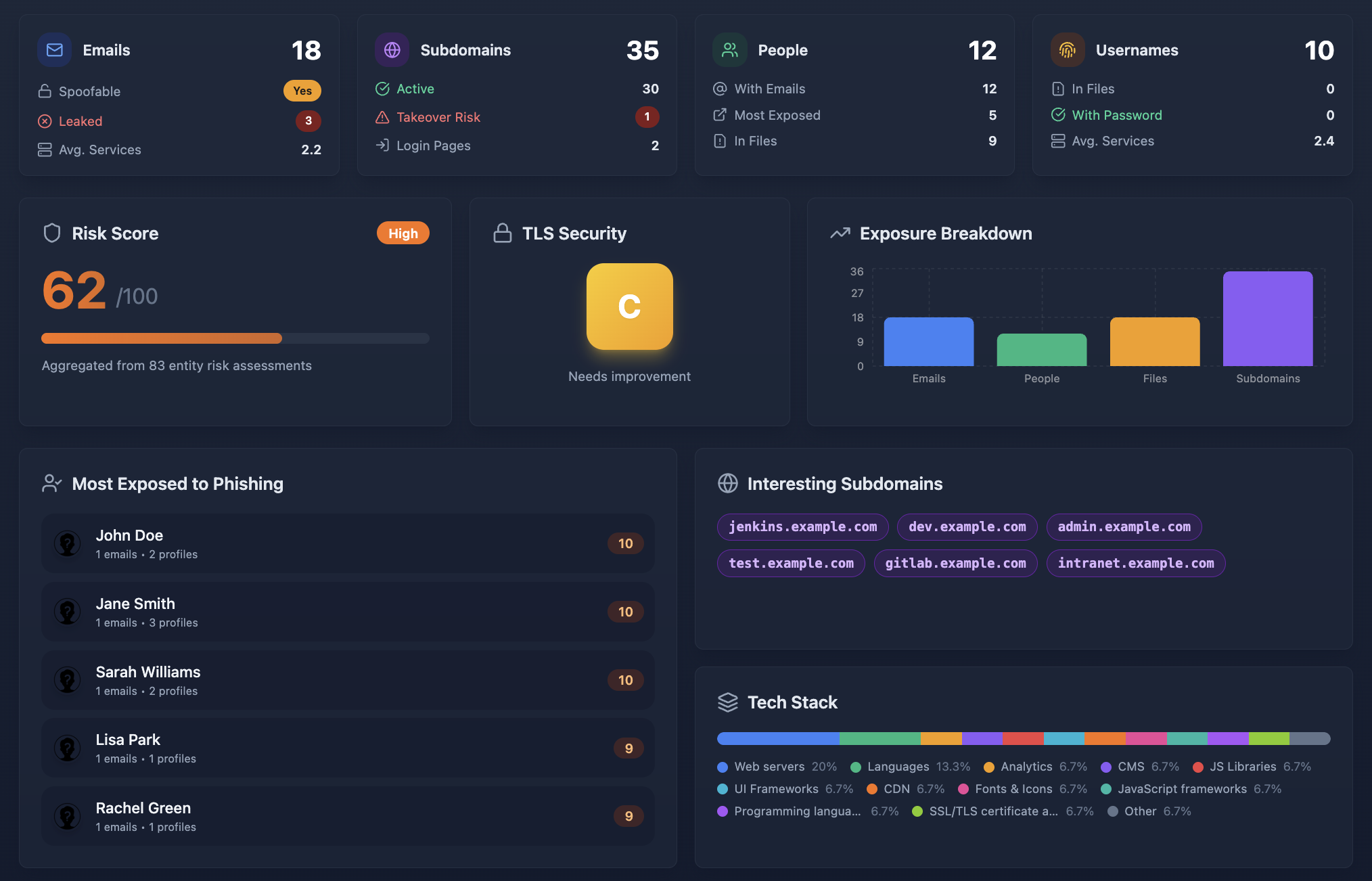
Cyborux addresses many of these challenges out of the box. Shadow IT and unmanaged assets surface automatically through external reconnaissance — no agents or internal access required. Asset sprawl becomes visible because every subdomain, email, exposed file, and third-party integration tied to your domain is discovered and correlated in a single dashboard. And because discovery runs continuously rather than on a manual schedule, accuracy does not decay over time — new assets are detected as they appear, not during the next quarterly review. For teams that lack the bandwidth to maintain a custom discovery pipeline, it replaces the operational overhead of stitching together multiple tools with a single domain entry point that delivers prioritized, actionable results.
Frequently Asked Questions
What is the difference between asset discovery and vulnerability scanning?
Asset discovery identifies what assets exist. Vulnerability scanning assesses those assets for known security weaknesses. Discovery must happen first — you cannot scan assets you do not know about. Think of asset discovery as building the map and vulnerability scanning as inspecting what is on the map. Most mature security programs run both processes continuously, with discovery feeding new assets directly into the scanning pipeline.
How often should we run asset discovery?
Continuous discovery is the gold standard. At minimum, external-facing assets should be monitored daily because new subdomains, services, and exposures can appear at any time. Internal asset discovery frequency depends on your environment’s rate of change — weekly for relatively static environments, daily or more frequently for dynamic cloud-native organizations. The key principle is that your discovery frequency should match your risk tolerance for operating with incomplete visibility.
Can asset discovery tools replace manual security assessments?
No. Asset discovery tools automate the identification and monitoring of assets but do not replace the judgment that experienced security professionals bring to assessments. Automated discovery is excellent at finding assets at scale, detecting changes, and maintaining continuous visibility. But understanding the business context of a finding, assessing complex attack chains, and making risk-based prioritization decisions still require human expertise. The best approach combines automated discovery for breadth with manual assessment for depth.
What is the difference between internal and external asset discovery?
Internal asset discovery scans networks and systems from inside the organization, using network access, agents, and authenticated scans to build detailed inventories. External asset discovery examines what is visible from the public internet, using the same techniques an attacker would employ — DNS enumeration, OSINT, certificate monitoring, and search engine analysis. Both perspectives are necessary because each reveals assets and exposures that the other cannot see.
How does asset discovery relate to attack surface management?
Asset discovery is the first and most critical step in attack surface management (ASM). ASM is a broader discipline that includes discovery, assessment, prioritization, and remediation of external exposures. You cannot manage an attack surface you have not first discovered. Organizations focused on reducing their external exposure typically start with asset discovery and then layer on vulnerability assessment, risk scoring, and continuous monitoring capabilities.
What types of organizations need asset discovery?
Every organization with an internet presence benefits from IT asset discovery, but it is particularly critical for organizations with complex environments: multiple domains, cloud infrastructure, remote workforces, acquisitions, or regulatory compliance requirements. Security consultancies, managed service providers, and IT managers at mid-size to enterprise organizations are primary users of asset discovery tools. Even small organizations with a single domain can discover surprising amounts of unmonitored exposure through basic external asset discovery.
Conclusion
IT asset discovery is not a nice-to-have — it is the foundation that every other security capability depends on. Without a complete, current view of your assets, vulnerability management has blind spots, compliance audits are incomplete, and incident response is slower than it needs to be.
The good news is that getting started does not require a massive investment. Begin with your known domains, run external discovery to map your actual footprint, and establish continuous monitoring to keep pace with changes. Every organization that takes this step discovers assets they did not know about — and each of those discoveries is an opportunity to close a gap before an attacker finds it.
The organizations that suffer breaches through unknown assets are not the ones that lack security tools. They are the ones that lack visibility. Asset discovery provides that visibility — and it is where every security program should start.