External Attack Surface Management (EASM): What It Is, Why It Matters, and How to Get Started
Here is a reality most security teams do not want to hear: attackers know more about your external exposure than you do.
They are not guessing. They are systematically enumerating your domains, discovering forgotten subdomains, identifying the technologies you run, finding employee emails in breach databases, and mapping every service you have exposed to the internet. And they are doing it continuously — not once a quarter during a scheduled penetration test.
External attack surface management exists to close that gap. It gives security teams the same visibility that attackers already have — and the ability to act on it before an exposure becomes an incident.
If you have ever wondered why your vulnerability scanner keeps missing assets, why your compliance audits uncover surprises, or why shadow IT seems impossible to track — this guide will explain how EASM solves these problems and how to evaluate whether your organization needs it.
What Is External Attack Surface Management?
The external attack surface management definition is straightforward: EASM is the continuous process of discovering, analyzing, prioritizing, and remediating internet-facing assets and exposures from an attacker’s perspective.
Let’s break that down.
Your external attack surface is everything an outsider can find about your organization without any internal access — domains, subdomains, IP addresses, open ports, web applications, cloud services, email addresses, exposed documents, leaked credentials, and third-party integrations. It is the sum of every digital asset that is reachable from the public internet.
Attack surface management is the discipline of maintaining visibility over these assets and their security posture. Unlike traditional vulnerability management (which scans assets you already know about), EASM starts from the assumption that you do not have a complete inventory. Its first job is discovery — finding assets you did not know existed.
This is what makes EASM different from almost every other security tool in your stack. Your firewall protects known perimeters. Your vulnerability scanner assesses known assets. Your SIEM monitors known logs. EASM finds the things that none of those tools are covering because nobody knew they were there.
What Is EASM and How Does It Differ from Traditional Security?
What is EASM in practical terms? Think of it as continuous, automated reconnaissance — the same techniques an attacker uses during the first phase of an attack, but performed by your security team (or an automated platform) on an ongoing basis.
Traditional security operates from the inside out. You define a network perimeter, deploy security controls at the boundary, and monitor what is inside. This model worked when organizations had a single data center and a defined set of public-facing applications.
That model is broken. Today, the average organization’s external footprint includes:
- Dozens to hundreds of domains accumulated through marketing campaigns, acquisitions, and regional operations
- Cloud services provisioned by individual teams without security review — sometimes across multiple providers
- SaaS integrations that expose APIs, authentication flows, and data to the internet
- Remote work infrastructure — VPN endpoints, remote desktop services, and collaboration tools
- Third-party vendor connections that extend trust (and risk) beyond organizational boundaries
- Employee digital footprints — emails, credentials, and personal information scattered across breach databases and social media
No firewall covers all of this. No vulnerability scanner has all of these targets in scope. EASM cybersecurity fills the gap by starting from the outside — discovering what exists, assessing what is exposed, and prioritizing what matters.
The Attacker’s Advantage
The reason EASM is necessary comes down to asymmetry. Attackers do not need internal access to begin an attack. Public data sources — OSINT techniques, DNS records, certificate transparency logs, search engine indexing, and breach databases — provide everything they need for initial reconnaissance.
A motivated attacker can discover your forgotten staging server, find the employee whose credentials were exposed in a third-party breach, and identify the unpatched CMS running on a subdomain you did not know about — all without touching your network. If your security team cannot see the same things, you are operating blind in the most critical phase of the attack lifecycle.
Why Traditional Security Approaches Fall Short
Most organizations already invest heavily in security. They run vulnerability scanners, deploy endpoint detection, conduct annual penetration tests, and maintain incident response plans. So why do breaches through unknown external assets keep happening?
Point-in-Time Assessments Miss Continuous Change
Penetration tests and vulnerability assessments are snapshots. They tell you what was exposed on the day the assessment ran. But your external attack surface changes constantly — a new subdomain appears on Monday, a developer exposes a debug endpoint on Wednesday, an employee’s credentials leak in a breach on Friday.
The gap between assessments is where risk accumulates. Attack surface management replaces periodic snapshots with continuous monitoring, ensuring that new exposures are detected in hours or days rather than months.
Asset Inventories Are Always Incomplete
Traditional security depends on knowing what you have. Vulnerability scanners need target lists. Firewall rules need defined perimeters. SIEM rules need defined log sources. But asset inventories are perpetually incomplete.
Research consistently shows that organizations discover 30 to 80 percent more external-facing assets when they first deploy an asset discovery tool. These are not obscure, low-risk assets — they include exposed admin panels, unpatched web applications, forgotten databases, and dangling DNS records vulnerable to subdomain takeover.
Internal Tools Cannot See External Exposure
Your endpoint detection platform sees managed devices. Your cloud security tool sees configured cloud accounts. Your vulnerability scanner sees the targets you give it. None of these tools can tell you what an attacker sees when they look at your organization from the outside.
EASM provides the external perspective that internal tools structurally cannot. It answers the question that matters most: “What can someone find about us right now, without any credentials or internal access?”
Core Components of External Attack Surface Management
A comprehensive EASM platform includes several integrated capabilities that work together to provide continuous external visibility.
Asset Discovery
Discovery is the foundation. EASM tools automatically identify all internet-facing assets associated with your organization, starting from seed information like root domains, IP ranges, or organization names. Discovery techniques include:
- Subdomain enumeration through DNS brute-forcing, certificate transparency logs, passive DNS databases, and search engine indexing
- IP range identification through WHOIS, BGP routing data, and reverse DNS lookups
- Cloud asset discovery by identifying services hosted on major cloud providers
- Technology fingerprinting that identifies frameworks, CMS platforms, server software, and third-party scripts
- Email and identity discovery from breach databases, social media, and public documents
- Google dorking to find indexed files, admin panels, and sensitive documents
The key differentiator of EASM discovery versus manual reconnaissance is automation and continuity. Discovery runs continuously, not once — ensuring that new assets are detected as soon as they appear.
Risk Assessment and Prioritization
Discovering thousands of assets is only useful if you can determine which ones matter. EASM platforms assess each discovered asset for:
- Vulnerability exposure — Is the asset running software with known CVEs?
- Configuration weaknesses — Are there default credentials, debug modes, or permissive access controls?
- Data sensitivity — Does the asset handle personal data, financial information, or credentials?
- Takeover risk — Are there dangling DNS records or unclaimed service registrations?
- Compliance relevance — Does the asset fall within scope of PCI DSS, GDPR, ISO 27001, or other frameworks?
Risk scoring transforms a flat list of discoveries into a prioritized action plan. Your team focuses on the exposed admin panel with default credentials before the static marketing page with no dynamic content.
Continuous Monitoring and Change Detection
Your external attack surface is not static. It changes every time someone provisions a cloud service, registers a subdomain, or pushes code to a public repository. Attack surface management includes continuous monitoring that detects:
- New assets appearing — Subdomains, services, and IP addresses that did not exist yesterday
- Configuration changes — SSL certificates expiring, new ports opening, security headers disappearing
- New exposures — Employee credentials appearing in fresh breach datasets, sensitive documents indexed by search engines
- Decommissioned assets — Services going offline, which may indicate either intentional cleanup or potential issues
Change detection with alerting ensures your team knows about significant changes as they happen — not during the next quarterly review.
Remediation Guidance
Identifying problems is only half the battle. Effective EASM tools provide actionable remediation guidance for each finding:
- Specific steps to resolve the issue (remove the DNS record, update the software, restrict access)
- Impact context explaining why the exposure matters
- Integration with ticketing systems to create and track remediation tasks
- Verification capabilities to confirm that remediation was successful
How EASM Works: From Seed Domain to Actionable Intelligence
Understanding how external attack surface management works in practice helps you evaluate what to expect from an EASM deployment.
Step 1: Seed Input
The process begins with seed information — typically your organization’s primary domain, known IP ranges, or company name. This is the starting point for automated discovery. Some platforms require extensive initial configuration. Others — like Cyborux — need just a single domain to begin comprehensive reconnaissance.
Step 2: Automated Reconnaissance
The platform executes dozens of discovery techniques in parallel:
- DNS enumeration and subdomain brute-forcing
- Certificate transparency log analysis
- Passive DNS database queries
- WHOIS and domain intelligence gathering
- Google dork execution for indexed files and exposed pages
- Email discovery from breach databases and public sources
- Technology fingerprinting via HTTP headers and JavaScript analysis
- Web archive analysis for historical infrastructure data
This phase mirrors exactly what an attacker would do during reconnaissance — but it runs continuously and feeds results directly into your security workflow.
Step 3: Correlation and Enrichment
Raw discovery data is noisy. A single server might appear as an IP address in one source, a hostname in another, and a cloud instance identifier in a third. EASM platforms correlate these signals to build a unified asset inventory:
- Linking subdomains to IP addresses to hosting providers
- Connecting email addresses to employee identities to associated services
- Matching discovered technologies to known vulnerability databases
- Identifying relationships between assets that reveal infrastructure patterns
AI-driven correlation is increasingly important here. Connecting a breached employee email to a specific subdomain that employee manages, then identifying that subdomain runs an outdated CMS version — this kind of multi-step correlation turns isolated data points into actionable intelligence.
Step 4: Risk Scoring and Prioritization
Each discovered asset and exposure receives a risk score based on severity, exploitability, business impact, and exposure level. This prioritization ensures your team works on what matters most rather than drowning in a flat list of thousands of findings.
Step 5: Alerting and Reporting
New discoveries and changes trigger alerts based on configurable thresholds. Critical exposures — like a new admin panel accessible without authentication — generate immediate notifications. Lower-risk changes are aggregated into periodic reports for review.
EASM Pipeline
Seed
Discover
Correlate
Score
Alert
Enter a single domain → platform discovers, correlates, scores, and alerts automatically
EASM vs. Other Security Disciplines
EASM overlaps with several other security disciplines but serves a distinct purpose. Understanding these differences helps you position EASM within your existing security program.
EASM vs. Vulnerability Management: Vulnerability management scans assets you already know about for known CVEs. EASM discovers assets you did not know about in the first place. They are complementary — EASM feeds newly discovered assets into your vulnerability management pipeline.
EASM vs. Penetration Testing: Penetration tests are deep, targeted assessments with defined scope and timeframes. EASM provides broad, continuous coverage across your entire external footprint. Pen tests go deep on specific targets; EASM goes wide across everything.
EASM vs. CAASM (Cyber Asset Attack Surface Management): CAASM aggregates asset data from internal tools (CMDBs, EDR, cloud platforms) via API integrations. EASM discovers assets from the outside that may not appear in any internal tool. Together, they provide complete internal-plus-external visibility.
EASM vs. Threat Intelligence: Threat intelligence focuses on understanding threat actors, their techniques, and their targets. EASM focuses on understanding your own exposure. Combining both tells you not just what is exposed but whether someone is actively targeting it.
Top Use Cases for External Attack Surface Management
EASM cybersecurity platforms address several critical use cases that traditional security tools leave uncovered.
Shadow IT Discovery
Teams across your organization adopt cloud services, deploy test environments, and create subdomains without going through IT or security. These shadow IT assets are invisible to internal tools but fully visible to attackers. EASM discovers them from the outside — the same way an attacker would.
Merger and Acquisition Due Diligence
When acquiring a company, you inherit their entire external attack surface — including every misconfigured server, leaked credential, and abandoned subdomain. Running EASM against an acquisition target before closing the deal reveals security risks that could affect valuation or require immediate remediation post-acquisition.
Compliance and Audit Readiness
Regulatory frameworks — PCI DSS, ISO 27001, NIST CSF, GDPR, SOC 2, CIS Controls — require accurate asset inventories and evidence of continuous monitoring. External attack surface management provides both: a comprehensive inventory of internet-facing assets and an audit trail of monitoring activity and remediation actions.
Third-Party Risk Assessment
Your vendors and partners extend your attack surface. When a supplier’s system is compromised, your data and integrations may be at risk. Some EASM platforms allow you to monitor third-party domains alongside your own, providing early warning of vendor security issues.
Incident Response Acceleration
When a critical vulnerability is disclosed — a zero-day in a popular framework, a remote code execution flaw in a widely used library — security teams need to know immediately which of their assets are affected. Organizations with continuous attack surface management can answer this question in minutes. Those without may need days of manual investigation.
Brand Protection
Attackers create lookalike domains, subdomain takeover pages, and phishing sites that abuse your brand. EASM platforms can detect these by monitoring for domains that closely resemble yours, identifying unauthorized use of your brand in SSL certificates, and flagging subdomain takeover conditions that could let attackers serve content under your trusted domain.
How to Evaluate EASM Vendors
The EASM market has grown rapidly, with dozens of EASM vendors offering varying levels of capability. Here is what to evaluate when choosing a platform.
Discovery Breadth and Depth
Not all EASM tools discover the same things. Evaluate whether the platform covers:
- Subdomain enumeration (passive and active methods)
- Email and identity discovery
- Technology fingerprinting
- Google dorking and search engine exposure
- Cloud asset identification
- Leaked credential monitoring
- Certificate transparency analysis
A platform that only discovers subdomains and IP addresses leaves significant blind spots in email exposure, document leakage, and identity-related risks.
Ease of Deployment
Some EASM vendors require weeks of onboarding, extensive configuration, and dedicated analyst time to maintain. Others are designed for fast time-to-value.
Cyborux takes the low-friction approach — enter a single domain and the platform handles the rest. No agents to install, no network access to configure, no wordlists to maintain. Discovery, analysis, and risk assessment run automatically, delivering results in minutes rather than days. This matters especially for small to mid-size security teams and consultancies that need comprehensive external visibility without dedicated EASM infrastructure.
Actionable Output vs. Data Overload
The difference between a useful EASM platform and a noisy one comes down to signal quality. Evaluate whether the tool provides:
- Prioritized findings with clear risk scores — not just a flat list of assets
- Remediation guidance that tells you what to do about each finding
- Change tracking that highlights what is new or different since the last scan
- Filtered views that let you focus on critical exposures without wading through low-risk noise
A tool that discovers 10,000 assets but cannot tell you which five matter most creates work rather than reducing it.
Coverage for Your Specific Environment
Consider your organization’s specific characteristics:
- Multiple domains? Ensure the platform handles multi-domain discovery efficiently.
- Cloud-heavy? Verify cloud asset detection across AWS, Azure, and GCP.
- International presence? Check whether discovery covers country-specific TLDs and regional infrastructure.
- Acquisition history? Confirm the platform can discover assets associated with previously acquired companies.
Pricing Model Transparency
EASM vendors use various pricing models — per asset, per domain, per user, or flat-rate. Understand:
- Whether pricing scales with the number of discovered assets (which may be unpredictable)
- What features are included in the base tier vs. premium add-ons
- Whether there are limits on scan frequency or historical data retention
- Total cost of ownership including onboarding, training, and integration effort
See what attackers see about your organization
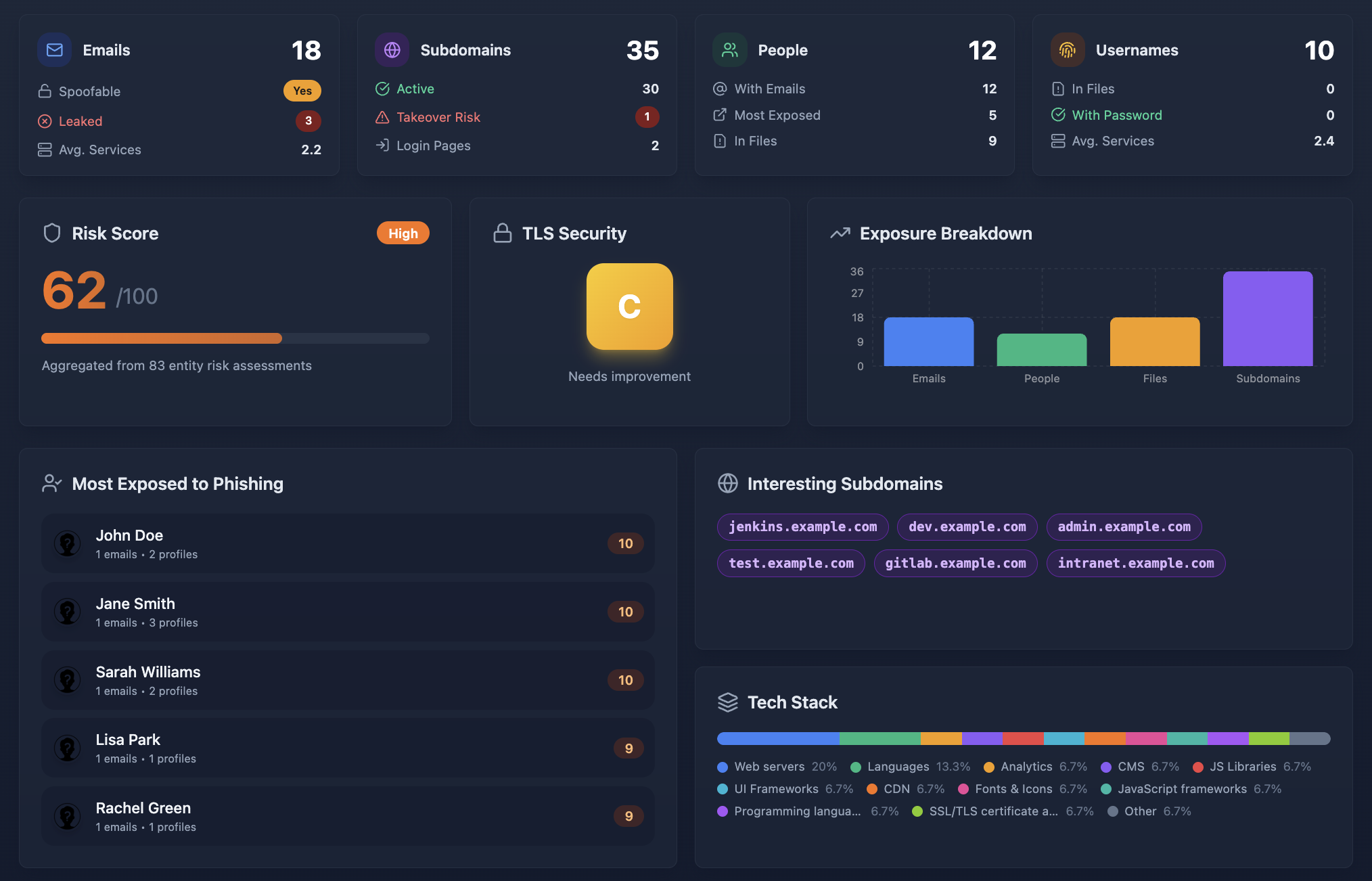
Cyborux maps your external attack surface automatically — subdomains, emails, exposed files, technologies, and more. Just enter your domain. No agents, no configuration, no complexity.
See Your ExposureCommon Challenges in Attack Surface Management
Even with the right platform, organizations encounter recurring challenges when implementing external attack surface management.
Alert Fatigue from Low-Quality Findings
A common complaint with EASM tools is overwhelming volume of low-priority alerts. When every discovered asset generates a notification, security teams quickly learn to ignore alerts altogether — including the critical ones.
How to address it: Choose platforms with strong risk scoring and filtering. Configure alerting thresholds that match your team’s capacity. Focus on high-severity changes (new exposed services, critical vulnerabilities, credential leaks) and aggregate lower-priority findings into weekly digests.
Organizational Resistance to Findings
EASM frequently discovers assets owned by teams that did not involve security in their deployment. Reporting these findings can create friction — the marketing team does not want to hear that their campaign microsite is insecure, and the development team does not want to take down their convenient staging environment.
How to address it: Frame EASM findings as organizational risk, not blame. Establish clear policies for external asset creation that include security review. Position EASM as a tool that helps teams maintain their services securely rather than a surveillance mechanism.
Keeping Pace with Cloud Sprawl
Cloud environments change faster than any monitoring tool can scan. A developer can provision, expose, and abandon a service between scan cycles.
How to address it: Supplement EASM with cloud-native security tools (CSPM, cloud provider APIs) for real-time visibility into cloud asset provisioning. Use EASM to validate the external visibility of cloud assets — confirming whether internally known cloud resources are actually exposed to the internet.
Defining and Maintaining Scope
As organizations grow through acquisitions, partnerships, and organic expansion, their external attack surface grows with them. Keeping EASM scope current requires ongoing effort.
How to address it: Regularly review and update seed domains and IP ranges. Use discovery features that automatically identify related domains through WHOIS registrant matching and infrastructure analysis. Assign clear ownership for EASM scope maintenance.
Getting Started with External Attack Surface Management
You do not need to deploy an enterprise platform on day one. A phased approach builds capability incrementally while delivering value at each stage.
Phase 1: Understand Your Current Exposure
Start by running discovery against your organization’s known domains. The goal is simple: find out what exists. You will almost certainly discover assets you did not know about — forgotten subdomains, exposed files, employee emails in breach databases, and services that were never properly decommissioned.
This initial discovery provides the baseline for everything that follows. Document every finding, identify asset owners, and flag immediate risks for remediation.
Phase 2: Establish Continuous Monitoring
Convert your initial discovery into an ongoing process. Configure monitoring for:
- Certificate transparency logs to detect new certificates for your domains
- DNS changes that reveal new subdomains or modified records
- Breach databases for newly exposed employee credentials
- Technology changes that might introduce new vulnerabilities
The goal is to reduce your time to discovery — the gap between when an asset appears and when your security team knows about it.
Phase 3: Integrate with Security Operations
Connect your EASM outputs to your broader security program:
- Feed discovered assets into your vulnerability scanner so they are automatically assessed
- Create tickets for newly discovered exposures so they enter your remediation workflow
- Include EASM findings in your risk register and compliance reporting
- Share discovery data with your SOC team for enhanced monitoring coverage
Phase 4: Expand Scope and Mature
As your EASM program matures, expand scope to cover:
- Subsidiary and acquired company domains
- Third-party vendor monitoring
- Digital footprint reduction initiatives based on discovery findings
- Executive and VIP exposure monitoring
- Brand protection and lookalike domain detection
Attack Surface Mapping Tools: Open-Source vs. Automated Platforms
Organizations approaching attack surface management for the first time often wonder whether open-source tools can replace commercial EASM platforms. The answer depends on your team’s capacity and requirements.
Open-Source Approach
Tools like Amass, Subfinder, and Nuclei provide powerful discovery and assessment capabilities at no licensing cost. Combining them with scripting and scheduling can approximate continuous monitoring. However, this approach requires:
- Significant analyst time to configure, run, and maintain multiple tools
- Custom scripting to correlate outputs from different tools into a unified view
- Infrastructure to host scheduled scans, store results, and generate reports
- Ongoing maintenance as tools are updated and data sources change
This approach works well for teams with strong technical skills and the capacity to invest in tooling. It is common in penetration testing firms and security consultancies where hands-on tool expertise is a core competency.
Automated Platform Approach
Commercial EASM tools and automated platforms package discovery, correlation, risk assessment, and monitoring into a single workflow. The trade-off is cost for capability:
- Immediate time-to-value — enter a domain and get results, no configuration required
- Unified interface — all findings in one place, correlated and deduplicated
- Continuous monitoring built in, not bolted on through custom scripting
- Risk scoring and prioritization that goes beyond raw discovery
- Reporting and compliance features for audit readiness
For organizations that need external visibility without building and maintaining a custom EASM stack, platforms like Cyborux provide comprehensive discovery and analysis with minimal setup — enter your domain, and the platform runs subdomain enumeration, email discovery, technology fingerprinting, Google dorking, and WHOIS analysis automatically.
Hybrid Approach
Many mature security programs use both. Open-source attack surface mapping tools handle targeted, deep-dive reconnaissance during penetration tests and incident investigations. Automated EASM platforms provide the always-on continuous monitoring that ensures new assets and exposures are caught between manual assessments.
Frequently Asked Questions
What does EASM stand for?
EASM stands for External Attack Surface Management. It is a cybersecurity discipline focused on continuously discovering, assessing, and managing an organization’s internet-facing assets and exposures. The term was popularized by Gartner’s research on emerging security technologies and has since become a recognized market category with dedicated vendors, tools, and best practices.
How is EASM different from vulnerability scanning?
Vulnerability scanning assesses known assets for known weaknesses. EASM discovers assets you did not know about — then assesses them. The critical difference is the starting point: vulnerability scanners require a target list, while EASM builds the target list from scratch by discovering what actually exists. Most organizations deploy both, with EASM feeding newly discovered assets into the vulnerability scanning pipeline.
How quickly can EASM provide results?
This varies significantly by vendor. Some EASM tools require days of initial scanning and configuration. Others deliver results much faster — Cyborux, for example, typically completes a comprehensive analysis in about an hour or less, covering subdomains, emails, exposed files, technology fingerprinting, and more from a single domain input. Continuous monitoring typically updates on daily or near-daily cycles after the initial discovery. When evaluating EASM vendors, ask for a demo with your actual domain to see real-time performance.
Is EASM only for large enterprises?
No. Any organization with an internet presence has an external attack surface — and it is often more complex than expected. Mid-size companies, startups with cloud-native infrastructure, and security consultancies serving multiple clients all benefit from external attack surface management. The key factor is not organization size but environment complexity: multiple domains, cloud services, remote workers, and third-party integrations all expand the attack surface regardless of company size.
What should I look for in EASM vendors?
Prioritize EASM vendors that offer comprehensive discovery (not just subdomains), actionable risk scoring, continuous monitoring with change detection, and low operational overhead. Consider time-to-value — how quickly you get results — and whether the platform integrates with your existing security stack. Pricing transparency and support quality are also important differentiators in a crowded market.
Can EASM replace penetration testing?
No. EASM and penetration testing are complementary. EASM provides continuous, broad coverage of your external attack surface — it is always watching. Penetration testing provides deep, targeted assessment of specific systems — it simulates actual attack scenarios. EASM helps you understand what you have. Pen testing helps you understand whether it can be exploited. Organizations benefit most from running both: EASM for continuous awareness and pen tests for depth.
Final Thoughts
External attack surface management is not a nice-to-have addition to your security program. It is the foundational capability that makes every other security investment more effective.
Without EASM, your vulnerability scanner only covers the assets you know about. Your compliance inventory is incomplete. Your incident response team wastes time identifying affected systems that should have been mapped months ago. And your penetration tests are scoped based on assumptions rather than reality.
The organizations that suffer breaches through unknown assets are not the ones that lack security tools. They are the ones that lack visibility into what needs protecting. Attack surface management provides that visibility — continuously, comprehensively, and from the perspective that matters most: the attacker’s.
Getting started is simpler than you might think. Cyborux lets you enter a single domain and handles the rest — subdomain enumeration, email discovery, file exposure, technology fingerprinting, and risk scoring run automatically, with results in under an hour. No agents, no configuration, no complexity. See what you have been missing, establish monitoring to stay ahead of changes, and build from there.
Your attackers are already doing this reconnaissance. The only question is whether you are doing it too.